How to Link Quality Issues to Production and Maintenance
DBR77 IRIS Team7 min read
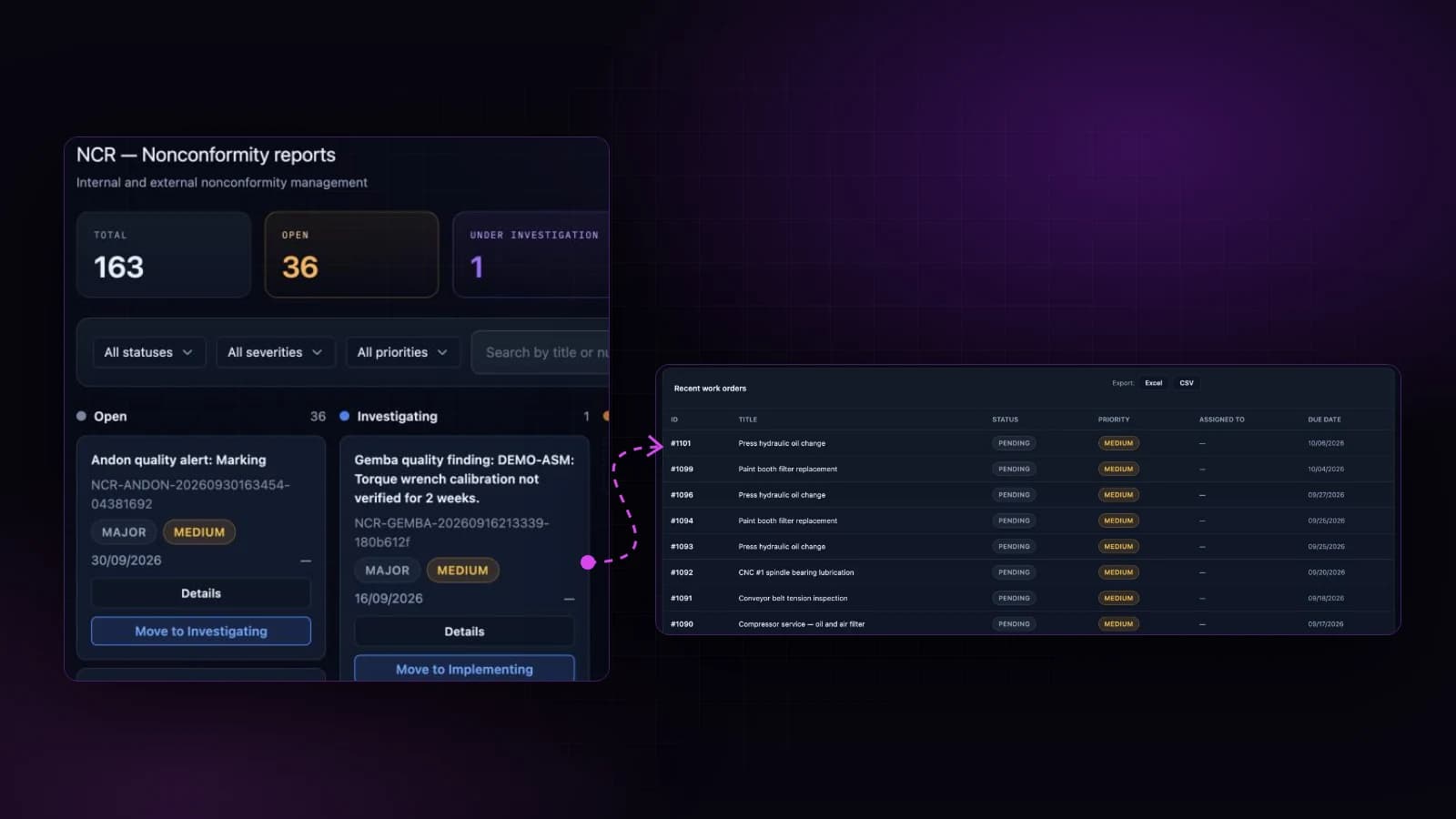
To link quality issues to production and maintenance, record every defect against the same order, machine, shift, material lot and asset ID that production and maintenance already use. Add the last setting change and the last work order on that machine. A defect search then starts from facts on one timeline instead of three people's memories, and most causes turn up where those records meet.
Quality teams are often the last to hear about a machine problem and the first to be asked about the defect it caused. Below: why the cause stays hidden, the links a defect record needs, how to move from containment to a verified cause, when quality should call in other departments, and how to tell that a fix held.
Why the cause stays unknown
In many plants, one defect lives in three places. The inspection result sits in a quality form or spreadsheet. The order, shift and operator sit in the MES or on paper. The repair done on the machine last Tuesday sits in the CMMS or in a technician's notebook. Each record is correct. None of them points to the others.
So the investigation turns into a phone round. The quality engineer asks the shift lead, who asks the setter, who remembers a tool change "around then". Days pass. The line keeps running, and suspect parts keep moving downstream.
That delay costs money. ASQ splits the cost of quality into four groups and separates internal failure costs, for defects found before the customer receives the product, from external failure costs, found after. Every day spent searching for a cause raises the chance that a defect moves from the first group to the second.
The links every defect record needs
A defect record becomes useful when it carries the same keys as production and maintenance. Six links cover most cases:
| Link | Where it comes from | Question it answers |
|---|---|---|
| Production order and part number | MES | Which orders and how many parts may be affected? |
| Machine, station and tool | MES, machine data | Is it one machine or all of them? |
| Time and shift | MES, inspection time stamp | When did it start, and which crew was on? |
| Material lot and supplier | Warehouse, receiving inspection | Does it follow a lot rather than a machine? |
| Last setting change | MES, setter log | What changed in the process just before? |
| Last work order on the asset | CMMS | Was the machine repaired, adjusted or overdue for service? |
With these six fields, the first ten minutes of an investigation are a filter, not a phone round. The OPC Foundation's summary of ISA-95 names production, quality, inventory and maintenance as the parts of an organization where coordination and control must occur. The links above are where those four areas meet one defect.
From containment to a verified cause
A structured method keeps the team honest. ASQ's 8D approach calls for containment actions to isolate the problem before the root cause work, and asks that causes be "verified or proved, not determined by fuzzy brainstorming". Linked records speed up both steps.
- Containment: the order, lot and time links show which parts to hold and which have already shipped.
- Cause: the machine, setting and work order links show what changed. Test that change, do not just name it.
- Correction: the fix is often a maintenance or process action, not a quality one. It needs an owner in that department.
The 5 Whys often lead straight into maintenance. In the Lean Enterprise Institute lexicon, Taiichi Ohno's classic example starts with a machine that stopped and ends, five questions later, at a missing strainer that let metal scraps into a lubrication pump.
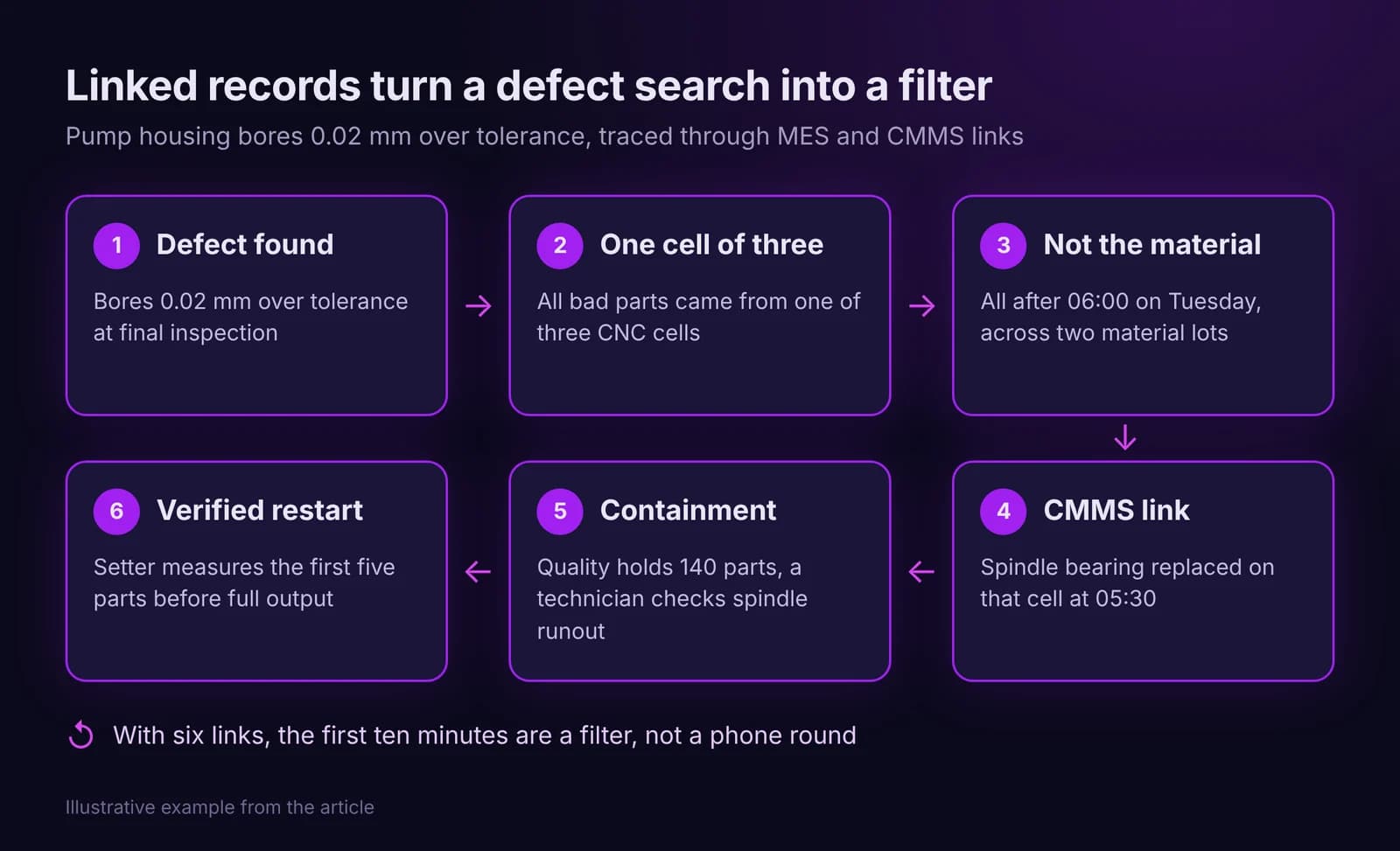
Illustrative example: a machining plant finds bores 0.02 mm over tolerance on pump housings at final inspection. The linked records show that all bad parts came from one of three CNC cells, all after 06:00 on Tuesday, across two material lots. So it is not the material. The CMMS link shows that a spindle bearing was replaced on that cell at 05:30. Quality holds 140 parts from the cell, a technician checks spindle runout, and the setter measures the first five parts after the correction before the cell returns to full output.
When quality should call in maintenance and production
Write down when a quality signal becomes a task for another department. Typical rules:
- Process out of control on an SPC chart: the operator stops or slows the process, and the setter gets a task within 15 minutes.
- Same defect on the same machine twice in a week: open a maintenance work order to inspect the tool, fixture or spindle.
- After a repair on a critical asset: a first-piece inspection before the machine returns to full output.
- Gauge overdue or out of calibration: review the results it produced since the last good check.
- Defect follows a material lot: block the lot in the warehouse and open a supplier complaint.
The link works both ways. NIST found that US establishments in the top 25% for reliance on reactive maintenance were associated with 16.0 times more defects than the bottom 25%. How to run the maintenance side is covered in How to Manage Maintenance With Data.
How to check that the fix held
A corrective action is closed when the result is measured, not when the form is signed. Set the check in advance: for example, the next 200 parts from that machine, or the next three deliveries from that supplier. If the defect returns, the action reopens with its history attached. This is the same owner and verification loop described in From Signal to Task to Closure: The Execution Loop.
How this works in DBR77 IRIS
In DBR77 IRIS, IRIS QMS shares one data model with IRIS MES, IRIS CMMS and IRIS WMS. A non-conformance is captured with its severity and linked to the production order, machine, operator and material lot. Disposition (rework, scrap, concession) is tracked to closure, and 8D and 5-Why workflows guide the team from containment to corrective action.
Inspections are triggered at production milestones and at receiving, where lots can be held or released. SPC charts alert operators when a process drifts out of control. Calibration and maintenance-related quality events are linked to asset records, and quality deviations create observations in IRIS Gemba for the shift. When a lot is rejected, IRIS MRP can trigger re-procurement.
When a non-conformance is opened, the AI in IRIS ranks probable root causes by likelihood, and LLMind explains its reasoning in plain language. The quality engineer decides which cause to test and which action to take. Approval rules are set per module, role and risk level, and every recommendation and decision is logged.
FAQ
Do we need SPC on every characteristic?
No. Start with the few characteristics that cause most scrap or complaints. Use inspection plans and sampling rules for the rest.
Who owns a corrective action that needs maintenance?
Quality owns the non-conformance. The maintenance task inside it has its own owner and deadline, and quality verifies the result.
Can we start without changing our MES or CMMS?
Yes, if the defect record can carry the same order and asset IDs. Shared keys matter more than a shared vendor at the start.
Conclusion
A defect with no links is a mystery. A defect linked to its order, machine, shift, lot, last setting change and last work order is usually a short investigation. Agree the shared keys with production and maintenance, write down when quality calls them in, and close every corrective action with a measured check.
Sources
- ASQ, What Is Cost of Quality (COQ)?
- ASQ, What Is 8D? Eight Disciplines Problem Solving Process
- Lean Enterprise Institute, 5 Whys
- OPC Foundation, OPC 10030 ISA-95 Common Object Model: ISA-95 Summary
- NIST, Manufacturing Machinery Maintenance