What Factory Jobs Change First in AI-Assisted Operations
3 min read
Factory jobs change first where time disappears into reconciliation: scanning inboxes, retyping context, chasing owners, preparing handoffs, and rebuilding situational awareness for the next shift. Line leadership triage, maintenance coordinators, quality release roles, production planners, and warehouse expeditors often feel the earliest shifts—not because machines stopped needing people, but because coordination work becomes visible, structured, and partially drafted. Physical craft changes later. Early change is usually more verification and exception handling, not fewer hands on tools.
Some work does not change on day one in most plants: licensed trades executing repairs under existing safety rules, inspections regulations require humans to perform, changeover craft where feel and experience still dominate, and subjective customer-facing quality judgments. Assistance can support these roles; it rarely replaces their core physical or legal moments first.
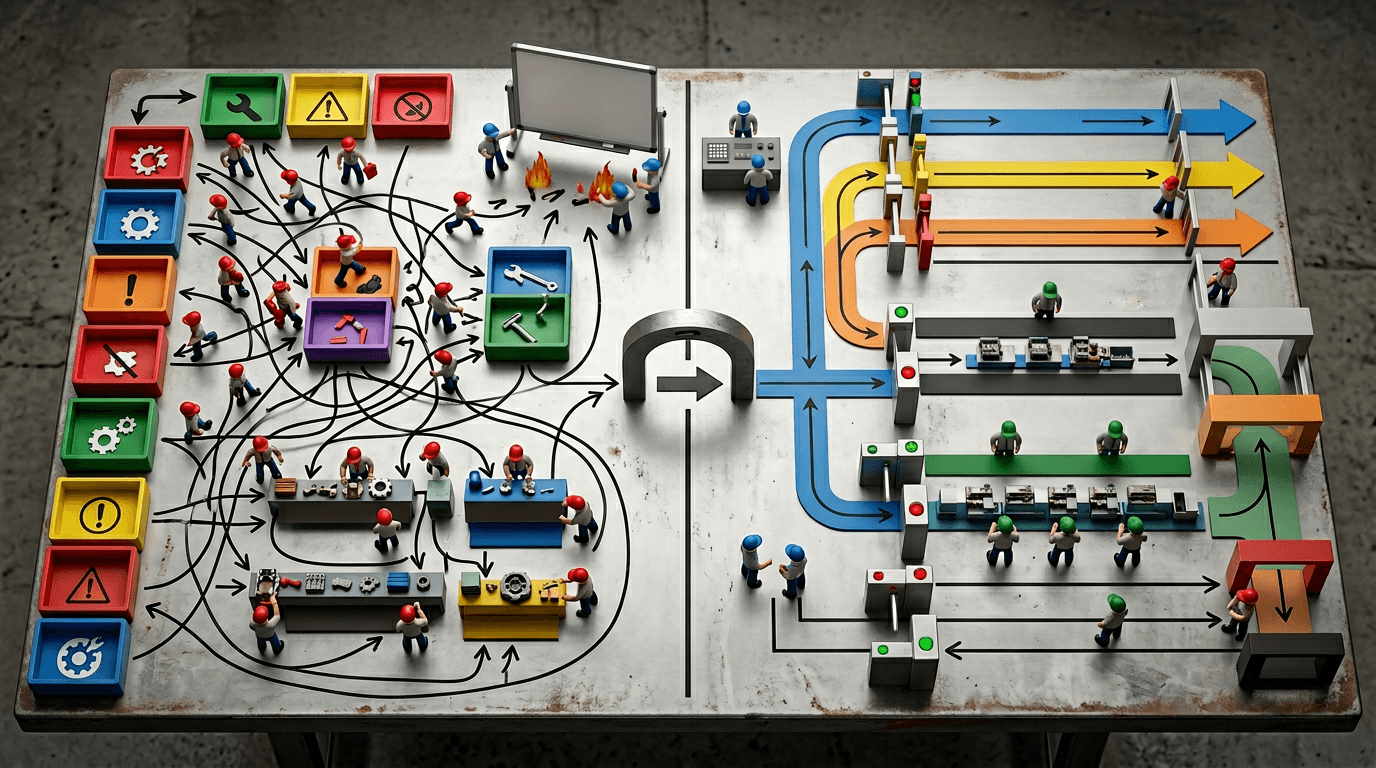
The pattern across roles is coordination compression. Supervisors move from scattered triage toward ranked exceptions with suggested owners. Coordinators move from rebuilding work packages from notes toward editing drafted packages with asset context. Quality release moves from chasing signatures toward a single queue with explicit approval states. Planners move from spreadsheet reconciliation toward exception lists when plans break thresholds. Expeditors move from manual cross-checks toward prioritized gaps tied to production start.
Skills rise in value around stating acceptance criteria for outputs, documenting overrides with reason codes, teaching clean intake fields, and reviewing false positives weekly with engineering. These are operational skills—not prompt-engineering theater.
Training should avoid morale damage: show the workflow with assistance off, establish baseline ownership, add advisory suggestions without auto-actions, practice reject, override, and escalate until habits exist, tighten thresholds only with measured error budgets. Skip the baseline step and people assume a hidden replacement agenda.
Tell the workload reshaping story, not the replacement fairy tale. The defensible claim is that the system drafts packets while humans verify and own outcomes—because that matches floor reality and keeps hiring and labor conversations grounded.
IRIS keeps job changes inspectable by binding assistance to visible tasks, approvals, overrides, and escalations—so coordination redesign does not depend on myth.
For operating modes behind new responsibilities, pair with When AI Should Watch, Advise, or Act in the Factory.
The shift in daily work is often subtle but decisive: less time spent reconstructing context, more time spent verifying and signing off on structured proposals. That can feel like “more scrutiny” before it feels like “more speed,” which is why change management matters. If the plant communicates only speed, people hear risk. If the plant communicates clearer ownership and fewer mystery handoffs, people hear relief. The same tool rollout can land as threat or upgrade depending on whether responsibilities are made explicit before thresholds tighten.
HR and union-facing leaders should also expect new questions about performance management: what good override documentation looks like, how reason codes are used in coaching, and how assistance metrics relate to accountability without becoming surveillance theater. The credible answer is that the system makes work visible—not to punish, but to remove ambiguity about who approved what under pressure. Visibility without fairness erodes trust; visibility with clear rules strengthens it.
Jobs change first in coordination layers. Design training, thresholds, and governance there before claiming transformation at the spindle.
The operational bottom line
The promise of this article—a role-based map of early changes focused on coordination, verification, and closure work, not generic "AI replaces operators" claims—becomes operational only when it changes how work moves: clearer ownership, faster first assignment, and closure you can trace without inbox archaeology. For “What Factory Jobs Change First in AI-Assisted Operations,” treat that as the acceptance test: the next shift should be able to read what happened, what was approved, and what remains open—without relying on verbal reconstruction.
That standard is not about software perfection; it is about operational honesty: fewer mystery handoffs, fewer truths reconciled only in meetings, and more days where the system record matches what the floor would say if you stopped them mid-task.
DBR77 IRIS makes role changes inspectable by binding assistance to tasks, approvals, and closure records supervisors already recognize. Start interactive demo or Watch walkthrough.