What a Plant Operating System Actually Means
4 min read

The phrase “plant operating system” sounds ambitious. For many buyers, it also sounds vague—and vague categories are dangerous in manufacturing, where capital, uptime, and safety do not forgive fuzzy thinking. When a term is interesting but undefined, the market fills the gap with confusion. Some people hear “another MES.” Some hear “a dashboard platform.” Some hear “a software umbrella that sits above what we already bought.” None of those shorthand translations capture what a serious plant actually needs, which is not more interfaces but one coherent way to run the day.
A plant operating system is not simply a bigger MES. MES remains foundational for many environments because it anchors production execution: orders, sequences, line states, and shop-floor discipline. The limitation shows up at the boundaries. Modern performance is rarely decided only by what happens inside the line logic. It is decided by how production interacts with warehouse reality, quality holds, maintenance response, internal communication, and the invisible work of task ownership across teams. A plant operating system exists to expand the conversation from production monitoring to plant-wide execution—to make “how we run the plant” a single operational story instead of a set of parallel stories that must be reconciled by people.
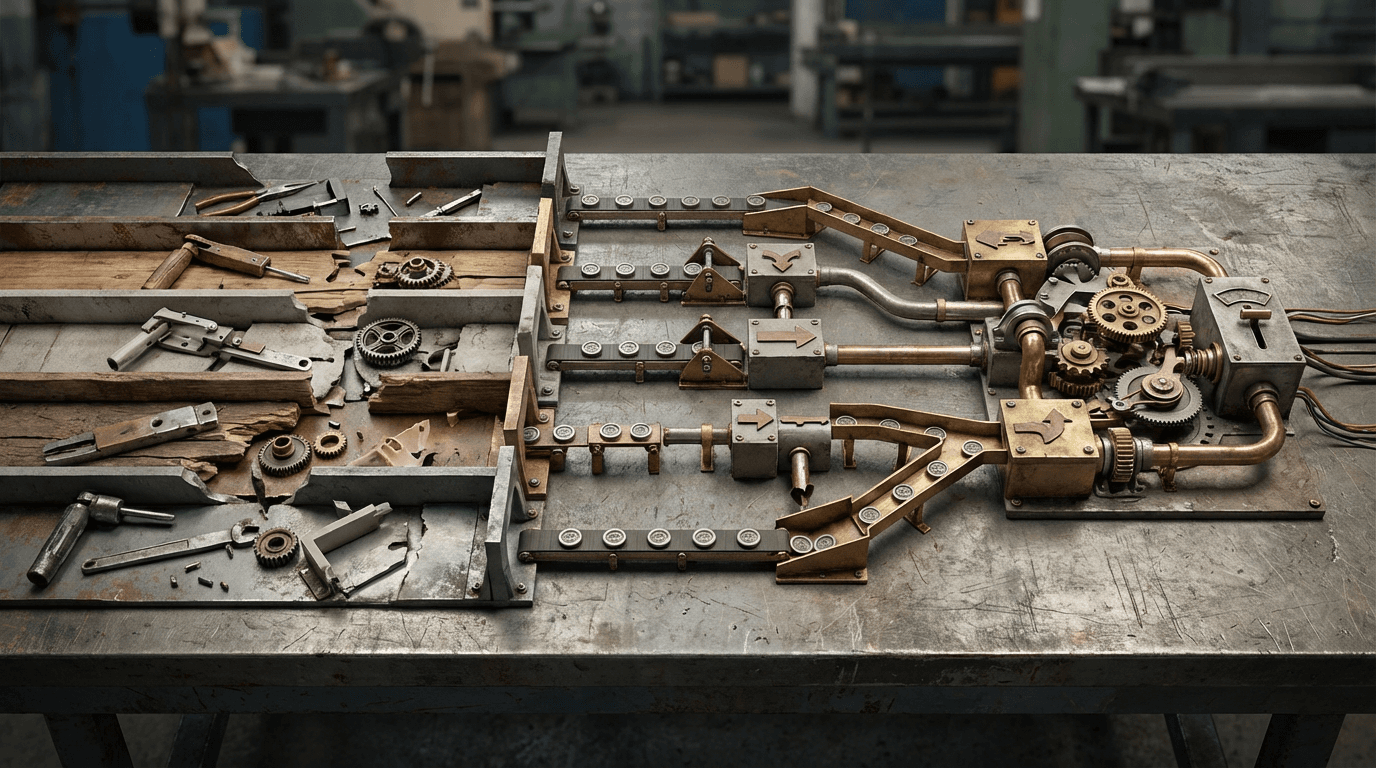
The point is not software breadth for its own sake. A plant operating system is valuable when it creates one operational logic: a shared data layer people can trust, stable definitions that do not change by department, a consistent path from issue to action, and an environment where different functions work from the same interpretation of what is happening now. Without that coherence, the plant still behaves like disconnected departments with prettier glass. The software stack may look modern. The operating model can remain stubbornly pre-digital.
Category confusion survives longest in places that mistake coverage for unity. There is an MES. There is a maintenance tool. There is warehouse software and a KPI layer. On paper, the architecture looks complete. On the floor, the plant may still lack one shared route from issue to owner to follow-up. The systems coexist without orchestrating the day. That is the gap a plant operating system is meant to address: not replacing every specialized tool overnight, but giving the organization one place where operational truth becomes actionable.
Factories do not improve because information exists somewhere. They improve because information changes behavior. That only happens when the system can carry the plant through a full loop: signal, interpretation, decision, task, follow-up. A plant operating system must therefore do more than collect and visualize. It must help the organization execute—especially where work crosses functions and where the cost of delay is measured in minutes, not meetings.
Shared definitions are part of the value, not a documentation hobby. Many factories suffer not from missing KPIs but from conflicting meanings. Operations, maintenance, finance, and quality can each be “right” within their own frame while the plant, as a whole, cannot align. Once semantic drift becomes normal, improvement slows because every important conversation begins with translation. A plant operating system earns its keep when it becomes the operational reference point that reduces invisible disagreement.
AI only matters in this context if it is embedded in decisions and workflows—not when it produces abstract summaries that still require a separate human project to turn into work. In a real plant operating system, AI should help detect patterns, recommend next actions, support prioritization, and route tasks to the right roles. That is where “AI-native” starts to mean something a shift supervisor can recognize as useful, not something a vendor can claim in a headline.
The category matters now because plants have accumulated systems over time in layers: MES here, spreadsheets there, maintenance in one place, warehouse logic elsewhere, communication outside the stack. Complexity is not only an IT problem. It is an execution problem. The idea of a plant operating system is relevant because it offers a path to unify operations without pretending that one dashboard or one point solution is enough.
IRIS is positioned as the first AI-native plant operating system. The practical implication for leadership is not “more modules.” It is one system for production, warehouse, quality, maintenance, and tasking; one data layer; one execution environment; one path from insight to action. For leadership, the value is better decision quality under pressure: one operational truth, clearer bottlenecks, visible ownership, and follow-up that happens inside the same system that produced the signal.
Before you buy the category, pressure-test it: Can two functions explain the same event the same way? Does an issue create owned work, or another meeting? Can you trace signal to closure without reconstructing the story from inboxes? If the answer is shaky, you are still shopping for software. If the answer is strong, you are shopping for an operating advantage.
A plant operating system should not be treated as a buzzword. It should be understood as a practical operating layer: one truth, one workflow logic, one execution loop. That is what manufacturers increasingly need as plants become more connected, more data-rich, and more operationally complex—because complexity without coherence does not create control. It creates drag.
IRIS gives manufacturers one AI-native operating layer across production, warehouse, quality, maintenance, communication, and tasking. Start interactive demo or Start 14-day trial.