How to Design an Exception Handling Model for AI-Assisted Operations
3 min read

Assisted operations do not usually fail because the model is wrong on day one. They fail because exceptions become a second shadow process—fast signals without a matching execution path, borderline cases that humans used to absorb quietly, and volume that turns into phone calls because the official model never included a fifth lane. Design exceptions on purpose, or the floor will design them for you.
When assistance goes live, expect more candidate tasks, more near-threshold disagreements, and more “almost auto” routes that need a human stamp. If you do not design the exception layer, informal channels become the real system.
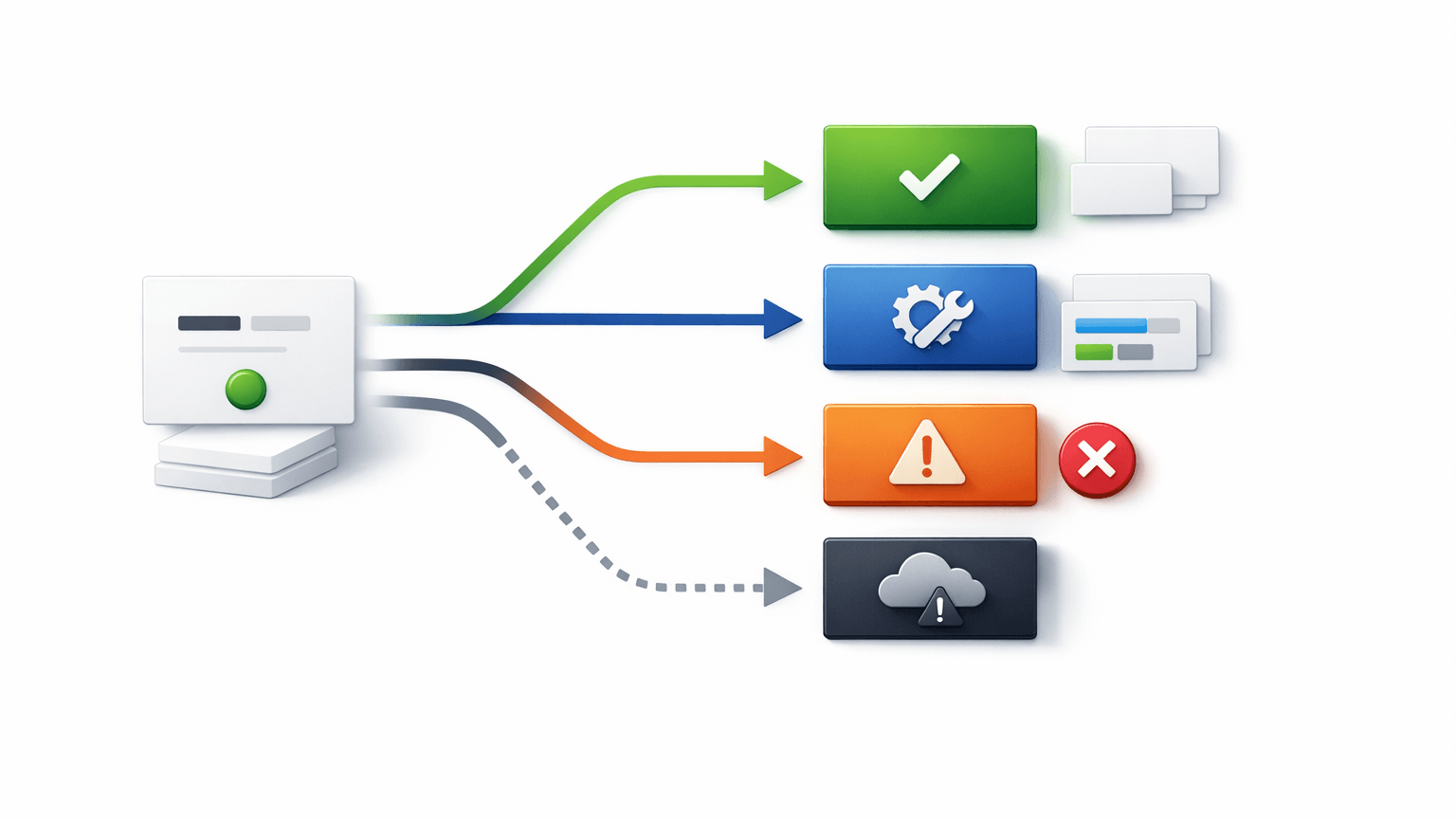
A workable model classifies assisted outputs into a small number of paths. Auto-task within published thresholds creates a task with rule version and timestamp, and closes with completed work or verified state. Advise-only signals require a human claim, with explicit dismiss or convert-to-task records even on rejection. Escalation paths apply when SLA risk, safety, quality holds, or cross-function conflict appears—each with a tier owner and due time. Hard stops apply for regulatory locks, customer constraints, or immature data—requiring approval roles, evidence links, and release criteria. If a fifth path appears in practice (“just ask the engineer”), your model is incomplete.
Before go-live, define a taxonomy for exceptions, an ownership matrix by shift, a time-based escalation ladder, approval rules with deputy coverage, handoff fields the next shift must see in the system, a rollback hook that pauses assisted routing without losing audit history, and a post-incident loop that forces threshold or training updates when patterns repeat.
Ticket culture logs activity. Closure culture finishes operational states. AI assistance amplifies ticket culture unless tasks bind to outcomes: time-to-owner, time-to-closure, and evidence that the line is safe, sorted, and documented.
Roll out calmly: shadow-tag exceptions without auto-routing, review weekly themes, publish version one for a few workflows only, measure time-to-owner and repeat escalations, version the rulebook when thresholds move.
IRIS fits the exception layer when assistance, tasks, approvals, and closure proof share one execution record—turning exception design into an operating contract instead of chat archaeology.
For neighboring hardening, see When a Factory Needs One Operational Arbiter for Conflicting Signals, How to Create Audit-Ready Records for AI-Assisted Factory Decisions, and What Full Operational Closure Should Look Like in an AI-Native Factory.
Exception volume is also a diagnostic. If exceptions cluster around missing fields, your intake is immature. If they cluster around policy conflicts, your definitions are misaligned. If they cluster around night shift coverage, your approval model is unrealistic. A good exception model is not only a router; it is a sensor that tells leadership where the operating system is still fragile—before fragility becomes downtime.
Supervisors will adopt exception paths only if they are faster than the informal path. That means time boxes must be real, owners must be reachable, and escalation must produce relief—not another loop. If the official exception path is slower than calling a favorite engineer, the engineer becomes the system. Design for that competitive reality.
Exception design is ownership design. Name responders, time boxes, and closure fields—then the plant can absorb higher assisted volume without losing control.
The operational bottom line
The promise of this article—a compact exception model with typed paths, thresholds, approvals, and audit fields that supervisors can run under load—becomes operational only when it changes how work moves: clearer ownership, faster first assignment, and closure you can trace without inbox archaeology. For “How to Design an Exception Handling Model for AI-Assisted Operations,” treat that as the acceptance test: the next shift should be able to read what happened, what was approved, and what remains open—without relying on verbal reconstruction.
That standard is not about software perfection; it is about operational honesty: fewer mystery handoffs, fewer truths reconciled only in meetings, and more days where the system record matches what the floor would say if you stopped them mid-task.
DBR77 IRIS keeps assistance, tasks, approvals, and exceptions on one execution record so paths and ownership stay visible across shifts. Start interactive demo or Start 14-day trial.